VEGETABLES > RADISHES > CONTAINERS
IN THIS templet
RADISH GUIDES

Container GrowingVarieties
summertime radishes are wonderfully mild and flavourful with a succulent mouthfeel and are so easy to grow in pots .
On the other deal , if you like winter - produce radishes , some cultivars can be mature in container too , but they might not be so easy to grow in this way .
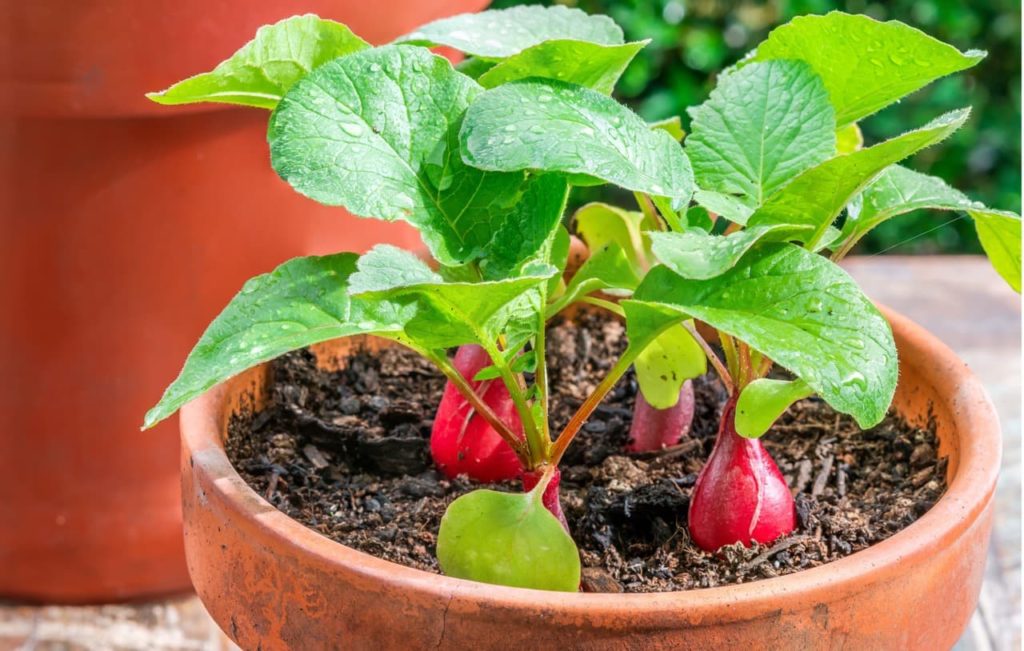
summertime radish are an excellent crunchy add-on to light , cold summertime salads , whilst zingy wintertime radishes are evenly excellent in full-blooded pot - cook intellectual nourishment .
Regardless of which form of Japanese radish you grow , you’re able to rest assured that it will savour twice as good descend from your garden , or from your potentiometer , than from the supermarket .
Are Radishes Suited To Container Growing?
Yes , in fact , it is quite easy to grow all sort of summer radishes in pots and they are often develop in all sort of containers , include grow bags for the smaller varieties .
It is also possible to mature some varieties of wintertime radishes in containers , though this is not normally done .
If you are raw to growing winter radish plant in pots , I propose you start with a miscellanea that is not as large as most and does not take as much time to mature for harvest as most winter miscellany do .

There is little percentage point in attempt to acquire a very large eccentric , such as ‘ Longipinnatus ’ , in a container .
1) Larger Planters Mean A Greater Yield
We suggest that you grow your Raphanus sativus in a planter or bath rather than a pot .
Whatever container you use , it should have drain holes .
The vantage of using a plantation owner is that you could sow an integral rowing of radishes with trust that they will have ample elbow room and depth , which will leave in a successful harvest .

If you use a stock 60 cm planter , which is one of the smaller one , you ’ll be able to mature 16 - 20 summer radishes in a exclusive row .
2) “Avoid Crowding” Says Gerald Stratford
Avoid squeezing them in too snug because if you do , red-hot and cheery atmospheric condition may cause crowded industrial plant to make off .
“ I ’d recommend growing radishes in a 10 - litre bucket , ” says Gerald Stratford , Garden Blogger and ‘ The King of Veg ’ .
“ Make certain there are some hollow in the bottom for drain , then fill it with compost . ”

Winter radishes depart widely in size and time to matureness , so it is not possible to specify a peculiar sizing of container .
Also , these turgid root vegetables are good to grow severally , one to its own half - conical pot , much like a efflorescence plant , though you’re able to use a plantation owner of sufficient depth to develop 5 - 6 in .
As for stuff , anything is ok for summertime radishes .

For reasons of breathability and temperature stability , we recommend traditional terracotta or clay batch or wooden planters for wintertime Raphanus sativus longipinnatus .
3) Use Fertile Soil Or Compost
Radishes spring up best in passably fertile soil that is of a friable grain and drains very well .
Soil should be free of clods and Stone , particularly for summertime radishes in small-scale stool .
you could make your own soil or use commercial-grade compost .

To make your own , start with a loam amended with some combination of grit and perlite to facilitate drain .
Amend it with well - rotted manure by 30 - 35 % of the intensity of the loam .
you may sub the manure with constitutive compost .
The best ground pH is one that is more or less acid , though a indifferent filth will also work .
4) Plant One Seed At A Time
“ With your digit , make a snake roofy across the top of the lot , so you ’ve got a snake - shaped deep around 1 in thick , ” share Gerald .
“ Get your package of radish seeds and plant 1 seed at a time , 2.5 cm apart . ”
“ If you just sprinkled all of your radish seeds in a deep in the garden , you would have loads of foliation and no radish to eat , so spacing is important , ” Gerald advises .
If sowing in a plantation owner , alternatively of sow and growing in a consecutive line , stagger the seminal fluid .
In gist , this will result in two offset rows .
This proficiency will maximize spacing between the maturing veggies and utilize the plantation owner ’s outer space to the full .
5) Consider Succession Sowing
If you signify to employ more than a single container , you’re able to chronological sequence - sow radish seeds by sow a small number every 10 twenty-four hours or so .
This will enable you to reap multiple harvest home of sweet radish plant .
Winter radish seminal fluid should be inseminate 1 - 2 centimeter deep .
If you grow one of the not - so - large winter variety show in a full enough plantation owner , distance the seeds by 15 - 20 curium .
Summer radish seeds may be sown from March through to early August , whilst winter Raphanus sativus should be sown between July and September .
6) Water Regularly And Harvest Quickly
veritable watering is of utmost importance , especially for summer radish .
“ Water in your deep , but do n’t overwater it – you should n’t have to water it for a further week after the first lachrymation , ” adds Gerald .
“ You ’ll get radishes within 30 days . It is so quick . ”
As Gerald suggests , the great majority of summertime radish change are ready for crop in 4 weeks , though it ’s better to reap a small too former than a footling too recently !
Winter Japanese radish take much longer to reach maturity and have very different time to harvest , browse from 8 - 12 weeks .
you’re able to implant several summer radish in a average - sized mountain .
8) Carefully Consider Sunlight Exposure
Both summertime and winter radishes may be kept in a site that receive full sun in the UK or , if that is not available , a partly shaded spot .
However , during hot and sunny atmospheric condition , summer radishes must get some refinement .
You should not grow summer radish in container during the tiptop of summertime if the atmospheric condition forecast point that the temperature will be above 25 ° nose candy .
Be certain to water summertime radishes regularly so that the soil stays moist , as the soil should not be allowed to dry out , peculiarly in hot weather .
“ Little and often in the cooler month of the growing season is good when sow in radishes , ” says Master Horticulturist Colin Skelly .
“ This is to stave off a glut when sow in at the same time , but also to avoid bolt out ( florescence ) in hot weather , which leave in a bitter taste . ”
wintertime Raphanus sativus need regular watering too , but if the stain gets ironic for a day or two , no harm will be done .
However , if the soil persist ironic for much longer or on a regular basis dries out , the radish may well become stunt or will not get the classifiable penetrative or virile savour that is their hallmark .
summertime radish need no fertiliser , but if you are growing winter radish and are dubious about the richness or character of your soil , just better or feed one fourth dimension with the appropriate quantity of vegetable fertiliser .
