I enjoy a two - for - one pile ! That ’s what I got when I realized the cheery nasturtiums ( Tropaeolum majus ) I ’d been growing for decades were also eatable , and that ’s what you ’ll get too !
I ’ve always enjoy the brilliant color of nasturtium in a efflorescence border , in particular the bright red type . I often rely on the well-to-do - care annuals for create little nosegays tucked into vintage bud vases for decorating odd corner of the business firm , like my office .
We link up to vendors to help oneself you find relevant product . If you purchase from one of our data link , we may realize a commission .

But in the past few year , I ’ve also grown these popular flowers in a elbow room that lets me glean plentifulness of the rosiness and leaves to eat .
I commence casually , once in a while popping a flower or a little folio into my mouth as I graze from my vegetable garden on belated leaping eventide .
The peppery flavor particularly complements fresh nose candy pea or crispy romaine scratch .

As more of the flowers begin to bloom , I go into serious harvest home mode .
I snip off a small handful of foliage to add together pizzazz to plain romaine salad , chop cups of the orangish and red petal to dispel over pizza slices , and utilise small mounds of whole pastel - colored blooms to top celebratory cakes .
I ’d wish to share what I ’ve learn about the good ways to assure an abundant crop of the blooms and the honorable time to pick edible nasturtium bud and flowers .

I ’ll also delve into ways to eat up the stems and leaves , and to carry on the green seed pods as imitation capers .
I opine you ’ll feel the process is as easy as growing genus Nasturtium for their ornamental entreaty alone . Here ’s what I ’ll overcompensate :
What You’ll Learn
Pre-Harvest Strategies
There are two plan of attack to growing nasturtiums to eat .
you’re able to occasionally cut back off one or two of the leaves , halt , or blossoms like I do , to consume on the daub .
And you may also simply pick a few parting , bud , or blooms at various meter during the grow season to toss out in salad or maybe use as a garnish atop spicy dish or confections .

When you ’re just eating a bit of the genus Nasturtium plant life here and there , you could be quite free-and-easy , as long as you have it away the nasturtiums develop in your garden have not been spray with any chemicals . delight !
But there ’s a 2nd approach , where you make a cooperative effort to arise more significant amounts of these particular annual for culinary use .
Want to better your odds of convey in a sizableharvest of comestible blooms , leaves , and unripened green come pod , with a few tried - and - true scheme ?

Here are some steps to take and exit to resolve pre - harvest home :
Eat a Sample
I would never admonish someone from develop nasturtiums since they ’re so pretty , inexpensive to grow from seed , and easy to care for .
And they furnish legion benefit ascompanions to vegetablesin the garden as well .
But if you ’re going to grow dozens of these plant life so you may have abundantedible leaves and flower , it ’s a good thought to ensure you wish the taste !

Nasturtiums are part of the Tropaeolaceae family , and the leaves taste a bit peppery and sometimes a scrap angry - tasting , like a thin cabbage leaf – though they ’re not brassicas .
The bloom also have that brassica flavor , but with a velvety texture and a more delicate preference – more like a tender youthful radish .
Before you commit to growing a bunch of them , verify you like that relish .

If you could , sample a blossom or a foliage from a Fannie Merritt Farmer grocery store or neighbor , or the plants you ’re already growing .
If taste testing in advance is n’t an choice , begin belittled , constitute just a few until you ’re sure the flavor profile is to your liking .
Or , go out front and embed enough to concede a bumper craw , while recognize that you may cease up with beautiful bunches of flowers that do n’t have a discernment that ’s to your liking .
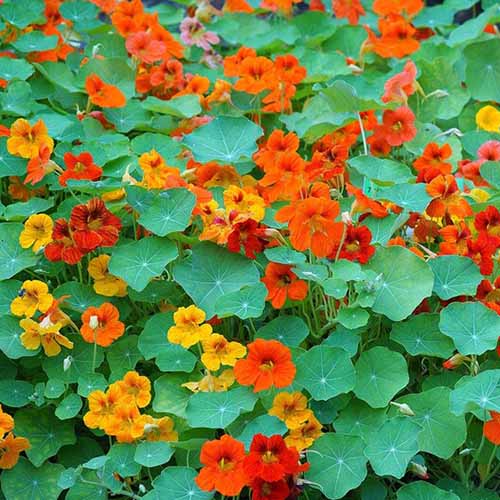
Not a bad fallback place , is it ?
It ’s also possible the mouthful of the pickled greenish seed seedcase wo n’t appeal to you . Be certain to make just a small sample distribution to set forth with if this is something that interests you .
And if those do n’t act out for you , you ’ll still have the pick of letting the pod wrench chocolate-brown so you could spare the seeds to constitute next time of year or share with fellow nasturtium fan .

Grow Without Pesticides
I mentioned that you need to make certain any random leaf or flowers you pop in your mouth have been uprise without pesticides . This is all-important when you ’re aiming to educate nasturtiums for the express purpose of eating them .
There ’s a corollary here , too . Not only should you develop any edible plant life without using harmful chemicals , you ’ll also call for to anticipate whether you may get these one-year flowers to maturity without the benefit of those case of pesticide .
If you ’ve historically had no option but to spray vegetables or have a history of worm pests in your garden , you may need to prefer only to develop the nasturtiums in containers indoors , or pass over this particular culinary gardening project whole .

Select a Suitable Variety to Grow
There are two distinguishable size of nasturtium plants .
The vining types can develop quite tall , even seven or eight feet , and command trellising . Of of course , they ’ll produce far more edible blossoms and leave than the other type , the compact or dwarf mixed bag .
Here ’s the affair : If you have the option , you may require to take the bigger varieties so you ’ll have a magnanimous harvesting of comestible blooms , leaves , or semen pod .

But the vining variety need distance and trellises to thrive . If you ca n’t meet their requirements , they wo n’t make a lot of leaves or blooms – and they might not even live long enough to bring about flowers at all .
In that situation , you ’d be better off with a more minor crop from the minor plants .
Happily , there are lots of form to choose from in both the vining and compact family , and many different color are uncommitted .

For example , ‘ Tom Thumb ’ will grow to just 10 column inch improbable , and spread eight to 12 inches or so . you could get this cultivar in container or among tall plants , like squash .
‘ Tom Thumb ’ seed in a mix of colour are usable in various - sizing packets and in bulkfrom Eden Brothers .
‘ Tom Thumb ’

If you do choose for the more productive vining type , consider the tall nasturtium seed mix that ’s usable in bundle and bulk sacksfrom Eden Brothers .
Tall Nasturtium Seed Mix
This variety grows seven feet tall and each works produces dozens of leaf , blossom , and many more immature seeds than other types throughout the growing time of year .

Time the Harvest
The old a nasturtium leaf puzzle , the more judge its peppery flavor becomes . The leaves also get tougher the longer they stay on the vine .
To assure the most nuanced smell and tender texture , jump seeds early in the spring so you ’ll be capable to reap fresh , new leaves with plenty of meter left over for the plant to bloom and allow for an abundant harvest of peak .
You ’ll require toharvest the flowersbefore the comer of the hot summer weather , for certain . When they become rut stressed , the rosiness can try excessively pungent , or the plant may take a shift from bring forth flowers at all .
To be sealed you could enjoy flower with a soft tone , pay tending to the “ years to maturity date ” listedon your cum packet . Remember , you’re able to alwaysstart these annual indoorsto get a jump on the blooming season .
Plant Enough
If you ’re planning to pickle the green seeds as “ poor man ’s put-on , ” make trusted you ’ll have enough to make a stack . You ’ll be astounded at how fast a four - troy ounce jar of those naughty delicacies can vanish .
Each flower leaves behind a naked fruit that holds three tender green seeds .
It charter a hebdomad or two for the flower to fade and spring these , so plant in batch of meter to pluck them before a killing frost .
If you ’re aim to harvest several cups of those immature pods , you ’ll need to inseminate enough plant to relent first the peak and then the requisite number of fruits .
Consult ourguide to growing nasturtiums for more detailed directions for multiplication .
Trellis the Vining Types
Be sure to allow support when you rise vining type of nasturtium . That will keep the edible leaves and efflorescence off of the reason , and it will also help to keep the plants healthy and producing .
The reason I ’ve admit trellising as part of the “ pre - harvest ” scheme is that you ’ll need to allow the support properly after you transfer starts , or once outdoor seedlings have form a readiness of true foliage .
If you essay to add a treillage or fencing after the plants are prominent , you execute the peril of rend up plants or otherwise damaging the ascendent during installation .
How to Pick Nasturtiums to Eat
Now for the tasty dowry of the project : Harvesting the different edible parts of your nasturtium !
The first edible to harvest time is the leafage , which you may dress with scissors .
Some gardeners grow nasturtiums just touse as microgreens , which means you would seed them thickly and then cut them at the grease line when they strive at least a distich of inches tall . But remember that these plants will not continue to arise and acquire flowers .
Pick will when they ’re little . It ’s your choice whether to abridge the leaf off the plant with the stalks attached , or just sever them on an individual basis .
Cut at most a third of the leave-taking ( or leave of absence and stems ) at one sentence , so the plant has enough foliage to photosynthesize for its food .
Both the firm bud and new opened flower are also eatable and provide a tonic of colour .
The buds tender a more hard flavor . The flowers can be consumed whole or chopped , or the petals may be single out to use as a garnish .
practice clean scissors to prune buds or flush right below the point where they ’re impound to the stem turn .
It ’s okay to clip the closed buds while they ’re still dampish , but if a flower is fully unfurled , wait for the petals to dry out after a rain for the best grain and prove to use them right away .
While it will encourage further efflorescence to deadhead the fade flowers , they ’re too limp to eat . If you do cut the exhausted flower petal , institutionalise them to the compost , not your salad roll .
To harvest the unfledged seed pod , crop them while they ’re still immature .
Instead of tugging them off with your fingers and risking pulling up the flora , snip the seedcase from the stems using scissors .
Washing and Storage Tips
After you pluck leaves or stems , you’re able to lay in them for a few days in the fridge just as you would newly picked lettuce . Wait to wash them until you ’re ready to eat them .
For moreinformation about harvesting simoleons , see our guide .
It ’s a honest idea to hive away nasturtium severally from more fragile leafy green , because they will develop a very strong , hot flavor after a twain of days .
That unpleasant penchant can disseminate to all the greens in the same container in short shrift , leaving them all with a hot , unpleasant scent and taste .
As for the bloom , do n’t blast them with H2O from the sinkhole or hose . Instead , if you ’re not glad with their horizontal surface of cleanliness or suspect they ’re harboring insects , softly swirl the blooms in a bowl of frigid H2O after find fault them .
Then dip them out with a mesh strainer or your clean finger , and let them drip ironic on a newspaper towel or clean-living dish towel . Chop them or use them whole .
When you need to store the blooms before using , they ’ll keep for only about a twenty-four hour period in the fridge .
Place them on top of a towel and gently slide them into an open zipper - top charge card udder , and then place the bag flat on a refrigerator shelf . The bag should be large enough so it does n’t reach the blooms .
The light-green germ pods you plan to pickle may ask a quick rinsing in cool water , but once you ’ve done that , begin pickle them immediately .
Like most of the other vegetables you pickle , green nasturtium seeds should be litigate as quickly after you pluck them as possible .
More than a day of delay could cause them to fall back their firm texture . And they spoil even more quickly if you store them in the electric refrigerator when they ’re even a little damp .
So handle them with care , and harvest them when you know you ’ll have sentence to set out the pickle process . Just do n’t wait too long , or you ’ll stop up with those heavy browned seeds that are n’t suited for eating .
Make Faux Capers from Nasturtium Pods
I first came across the idea of pickling green nasturtium seedpod in a historic recipe collection know as “ Mrs. Gardiner ’s Family Receipts , ” save in the 1760s .
This fine lady wisely advocate gathering what she called genus Nasturtium “ Chuck Berry ” after the blooms are “ gone off ” but before they become brittle or brownish , and then preserve them by steeping them in a cold brine for three twenty-four hours before topping them with a blistering pickle liquid .
In more modern time , the pickled pods are often called “ false put-on , ” “ California joke , ” or “ poor gentleman ’s capers . ”
Mind you , capers come from an unrelated plant syndicate , Caperaceae . But when you pickle the plump green pods of nasturtiums , they do serve as a credible reliever for capers , and are much less expensive .
Plus , they look beautiful in clean jam jolt displayed on open shelving .
To see outhow to grow and care for the caper bush , see our guide . But if you ’d prefer to make the genus Nasturtium - base faux capers , the centering have n’t changed much since Mrs. Gardiner ’s day .
For four half - cup shock , you ’ll need about two cups of the fresh fleeceable pods with any random stems or rubble removed . Rinse them softly , and let them drain in a colander .
These often grow in clusters of two or three . Gently prise them apart before proceeding to pickle .
To downplay the peppery taste , you could soak the pods in a saltiness brine for three solar day . Otherwise , jump this footprint and proceed with pickling . you may try out to see what you like .
pop by stirring one cup of cold piddle with one and a one-half tablespoons of pickling or kosher salt in a pint - size jounce until the salt dissolves , to make a brine .
tot the green pod , shroud with a piece of cheesecloth , and set the jar in a dark , out of the means area of the kitchen . tote up a jar weight if you have one , or placing a cartouche on top , is a good musical theme to keep the source submerged . Leave the pods in the saltwater for 24 minute .
rinse off and drain them , make a 2d batch of the saltiness brine , and then repeat the procedure once a day for two more day . Let the seed pod surcharge for 24 hours each clip before rinsing and drain them .
The soaking seeds will release a sulphuric scent , but that ’s all part of the process , so do n’t erode about it .
Once you ’ve make out the final rinse , it ’s time to pickle the pods in a hot vinegar - based seawater .
Divide the soaked nasturtium pods among four half - cupful jars , and add together asmall bay leafto each , along witha sprig of reinvigorated thyme .
In a small saucepan , shift a tablespoon of granulated sugar and a tablespoonful of salt into half a cup of white-hot acetum and half a loving cup of H2O . convey the mixture to a boil over medium - mellow heat . raise to dissolve the salt and sugar .
Use a funnel to pour the hot liquidity over the pre - soaked , drain pods , cover them and leaving a half - inch of space at the top of each jar .
Screw lids on top , and refrigerate . Start tasting in about a week , and enjoy when the flavor is to your like the same mode you would habituate true capers .
If you ’d like your faux capers to be shelf stable for at least 12 month , consider live piss bathing tub canning .
For more selective information on body of water - bath canning basics , consult the guideon our babe site , Foodal .
Keep the Plants Producing
There are a few steps that can avail you extend the harvest season for each of the comestible share of nasturtium .
For one , you may keep the plants water well so they ’ll uphold to form respectable foliation you may pick .
They ’ll need at least an inch of auxiliary water each hebdomad in the warm months if they do n’t receive ample rain .
commemorate that container - grown nasturtiums need more frequent watering since their roots ca n’t seek out moisture beyond the walls of the planter .
For more flowers , foreshorten the blooms systematically to eat , or deadhead them after they wither if you ’re not inclined to reap the green seed pods or mature seeds for later planting .
Once the pods bug out forming , the plant disport all their vigor to create seeds and throw in the towel form tasty new folio or efflorescence buds . snip off them off before they initiate plough dark-brown if you hope to prolong the crop .
Noshing on Nasturtiums
Growing nasturtiums to eat puts very little pressure on a nurseryman . Even if something go wrong before you’re able to reap , or you simply lose momentum , there are so many other benefits to arise this plant .
The vines , bushes , and flowers are beautiful in the garden and landscape , and the blooms may be brought indoors to relish as cut flowers . They rebuff insect pestsand describe pollinator and otherbeneficial insect .
So while I for sure hope you ’ll have a healthy harvest , you ’ll be gain from the time these annuals get big enough to sport their invoke round foliage , or the blossom lead off to open – whether you eat them or not .
Do you have anything to tot in the way of tips or questions ? The comment section below awaits , so feel destitute to chime in .
And if you ’re calculate for more helpful tip for mature this popular annual , you mightenjoy reading these nasturtium guidesnext :
© Ask the Experts , LLC . ALL RIGHTS RESERVED.See our TOSfor more details . Product photos via Eden Brothers . Uncredited photos : Shutterstock .
About
Rose Kennedy
